
Musty smell from vents in Hillsboro, OR

After you send the request, you're done searching.

Hand it off

Why do my vents smell musty in Hillsboro?

You turn on the furnace or the AC and that stale, damp smell comes through the house. It's not strong enough to call an emergency, but it's there every time the system runs, and you'd rather deal with it now than let it sit all winter.

Moisture sitting in your ductwork or on the evaporator coil

A musty smell from your vents almost always means moisture is sitting somewhere in the system instead of draining away. The evaporator coil stays wet every time your AC runs, and if the condensate drain is slow or the coil doesn't dry out between cycles, mold starts growing right there in the airflow. Dust and debris in the ductwork hold onto that moisture too, which gives it a place to settle in. With summers here staying humid even without the heat, that coil can stay damp longer than it would somewhere drier, and the smell tends to show up first when you switch between heating and cooling. Once mold is established in the ducts or on the coil, it keeps circulating that smell through every room the system reaches.

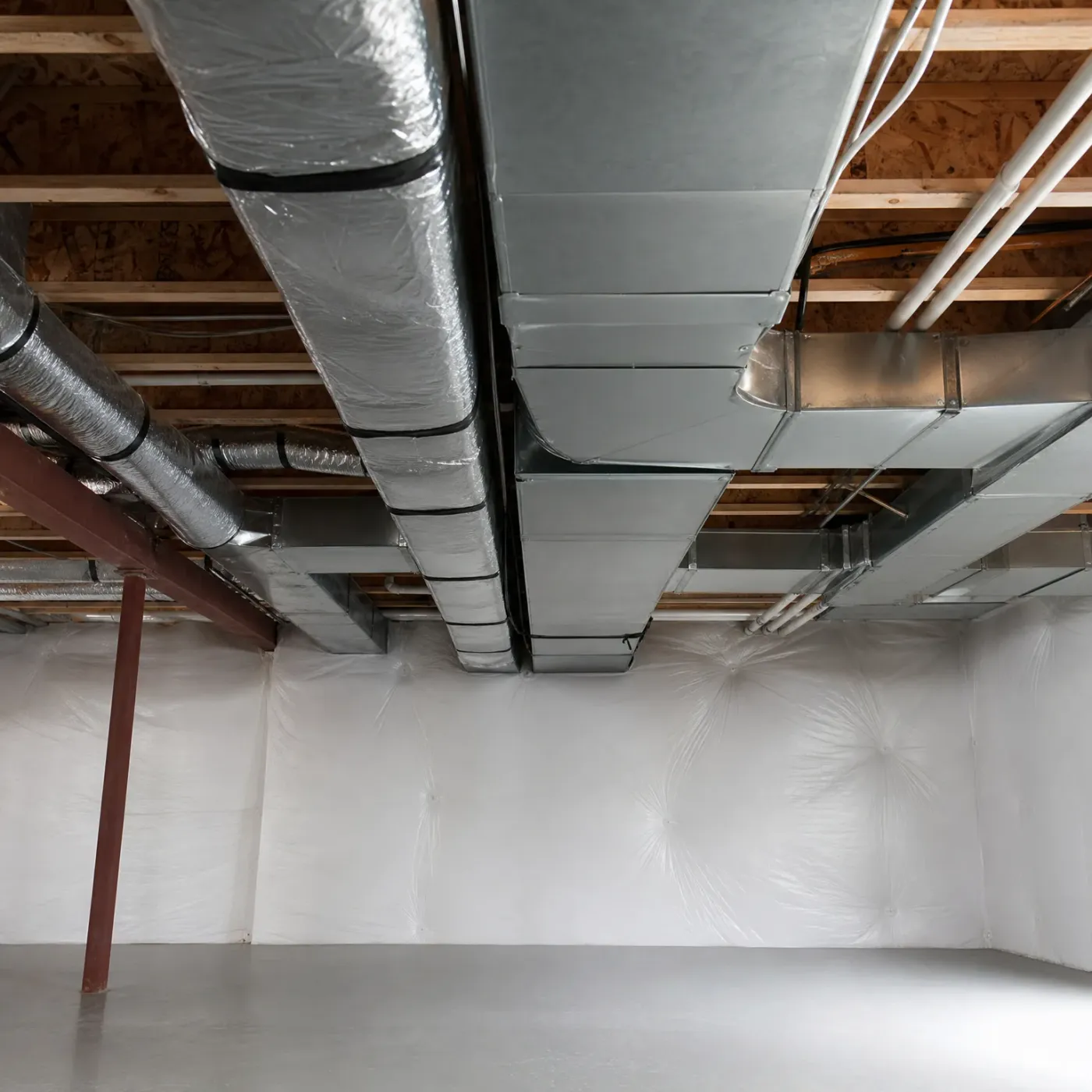
Unfinished basement with exposed wood joists, sheet metal and insulated flexible ductwork, white pipes, a steel support post, plastic-covered walls, and a bare concrete floor.

Clean, dry ductwork

Metal trunk lines and flex runs like these move air without adding anything to it. No film on the inside, no standing moisture at the joints, nothing for mold to hold onto. Air passes through and picks up nothing on the way to your vents.
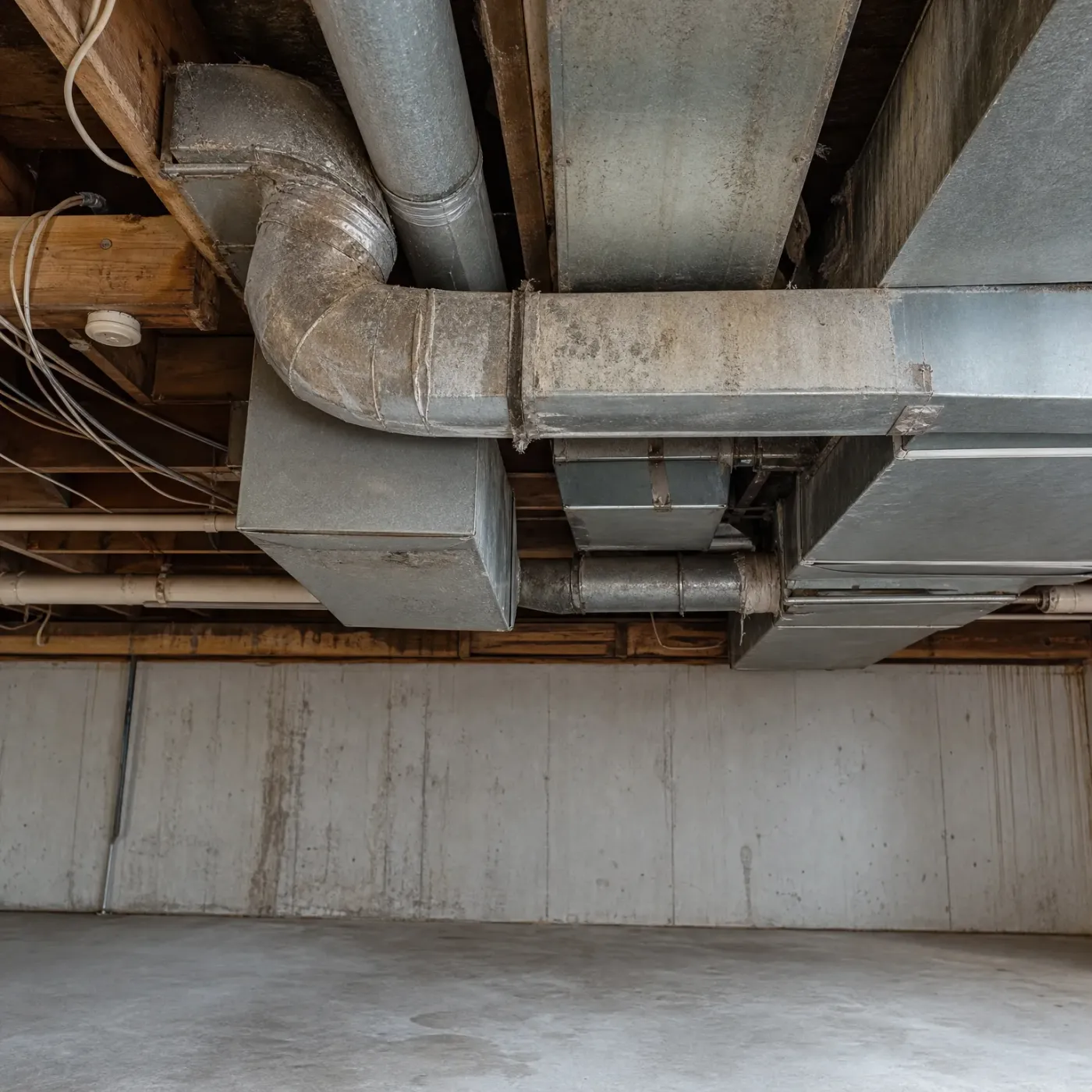
Galvanized sheet-metal ductwork and round pipes run beneath wooden floor joists in a basement with concrete walls and floor.

Ductwork holding moisture

Dust and debris build up inside the metal and settle at the seams, and where damp meets that buildup, mold starts. Every time the blower kicks on, it pushes that smell through the trunk lines and out your vents into the house.

Why does the smell keep coming back in a house like mine?

  • Half the homes here were built by 1990

    Half the homes in Washington County were built in 1990 or earlier. Older duct runs and joints have had more years to collect the dust and moisture that mold needs.

  • Heat runs October through June

    Heat runs here from October through June, about nine months out of twelve. That's nine months of warm, damp air moving through the same ducts, giving mold plenty of chances to take hold.

  • Power here costs 18.43 cents per kilowatt-hour

    Electricity here runs 18.43 cents per kilowatt-hour. A duct system clogged with buildup makes the blower work harder to push air through, and that cost shows up on your power bill.

ACS 2020-2024 · NOAA nClimDiv 1991-2020 · EIA-861 2025

Where the smell actually comes from

  • Mold needs a food source, and the dust and skin cells that settle inside ductwork give it one.
  • Condensation forms on the evaporator coil and drips into the drain pan below it.
  • A clogged or slow drain line lets that water sit in the pan instead of draining away.
  • Standing water in the pan and moisture on duct walls together are what let mold take hold.
  • The smell rides the airflow from wherever the mold is growing straight into the rooms you're standing in.
  • A return duct that runs through a damp crawlspace or attic can pull that odor into the system before it ever reaches the coil.

Your duct system isn't just pipe. It has a coil, a drain pan, and a drain line, and any one of them can start the problem. The evaporator coil gets cold enough during a cooling run to pull moisture out of the air, the same way a cold glass sweats on a warm day. That water has to go somewhere, so it drips into a drain pan underneath the coil and should run out through a drain line. When that line is clogged or barely draining, the water sits in the pan instead of leaving the system. Meanwhile, every home generates dust, skin cells, and other debris that settles inside the ductwork over time. Mold doesn't need much to get going. It needs moisture and something to feed on, and a system with a slow drain and dust-coated duct walls gives it both at once. Once it's established, whatever air moves through that duct carries the smell with it, out through the vents and into whatever room you're standing in. It isn't a one-time event. It happens every time the blower kicks on. There's also a path mold can take without ever touching the coil. If a return duct runs through a crawlspace or attic that holds damp air, the system can pull that smell in and distribute it before the air even reaches the coil.

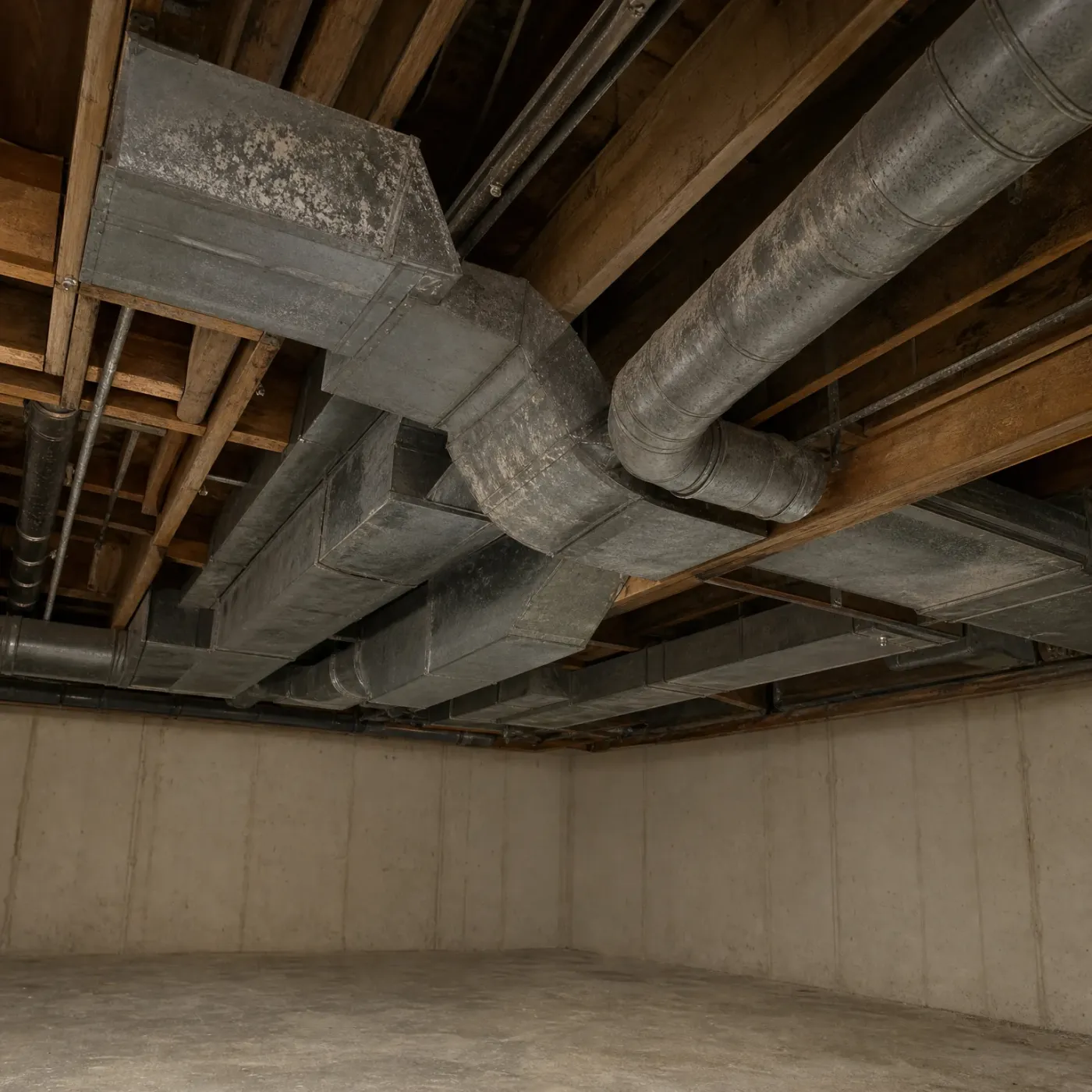
Empty concrete-walled basement room with exposed wooden joists and galvanized rectangular and round ductwork plus pipes running across the ceiling.
Before you get your ductwork cleaning
Empty concrete-walled basement room with bare floor and an exposed wood-joist ceiling carrying galvanized rectangular and round sheet-metal ducts, black pipes, and wiring.
After you get your ductwork cleaning

The smell isn't staying put in one room. Your furnace and AC push air through the whole duct system every time they run, so whatever is growing in there reaches every room on that system. You might notice it most walking into a bedroom that's been closed up, or catching it on a towel pulled from the linen closet. It's easy to stop smelling your own house, which is why someone visiting often notices it before you do. Beyond the smell, that same buildup makes the system work harder to move air through the house, and with what power costs in Washington County, that adds up over a winter of furnace runs. For anyone in the house with allergies or asthma, the spores moving through that airflow can mean more sneezing or sinus trouble, especially once the heat is running most days. None of this fixes itself. Left alone, the moisture and debris behind the smell tend to spread further into the duct runs rather than stay contained.

What that smell means for your house

  • Every time the furnace or AC kicks on, that air moves through your whole house, so the smell follows it into bedrooms and closets far from the mechanical room.
  • Clothes, bedding and upholstery can pick up a faint mustiness over time, even if you can't place where it's coming from.
  • Mold spores riding in that airflow can trigger sneezing, coughing or sinus irritation, especially for anyone in the house with allergies or asthma.
  • A system working to push air through ductwork with buildup on the walls runs longer to heat or cool the same rooms, and power in Washington County isn't cheap.
  • Left alone, the moisture and debris feeding the smell can spread further into the duct runs, turning a small patch into a larger one.
  • Guests or family who don't live in the house full time often notice the smell the moment they walk in, even when it's gone unnoticed by the people who live there every day.
A smiling man in a dark green sweater sits at a wooden table with a light gray mug in a kitchen with white tile backsplash, pendant lights, and an adjoining living room visible.
A smiling man in a dark gray sweater stands indoors looking to the side, with a kitchen counter holding a ceramic mug and open wooden shelves behind him and a living area in the background.
A smiling man in a dark blue button-up shirt stands at a white kitchen island, with open shelving, a gas range, a potted plant and a window in the background.
A smiling man with dark wavy hair and a beard, wearing a dark green knit sweater, sits in an open-plan living room and kitchen with a brown sofa, large windows, and a counter holding a mug and a wooden bowl.

It's off your list after this

That smell means something is holding moisture inside your ducts, and it won't clear on its own. You can run the furnace fan all day and it just keeps pushing that air through the house. Finding out where the moisture is coming from and getting the ductwork actually cleaned out takes someone who opens up systems like yours regularly, not a guess from a vent cover. A contractor working heating and cooling systems around Hillsboro sees this same complaint come up in houses with older duct runs and knows where mold tends to settle first, whether that's a drain pan, a joint in the flex duct, or a return that's been pulling in damp air from a crawlspace. Send the request and that search becomes someone else's job. One local contractor gets your information, not a handful of companies competing for the lead, so you're dealing with a single call back instead of sorting through several. That's one less thing sitting on your list while the smell is still coming through your vents.

Why the furnace makes it worse

Gas heat in Washington County runs from October through April, and every one of those months pushes air straight through the ducts carrying that smell. A furnace moves more air than an AC does over the course of a day, since it runs on more of the days in the year here. That's more passes through the same moldy runs, and more chances for the smell to reach rooms far from the mechanical closet. Running the fan on its own setting without the heat on doesn't help either. Air movement is what carries the smell, not the heat itself, so the furnace and the AC both spread it the same way once mold has taken hold somewhere in the line.

What a clean system feels like

Once the ductwork is clean, turning on the furnace or the AC just moves air. No smell rides along with it, because there's nothing left in the trunk lines or flex runs for it to pick up. You notice it first in the rooms farthest from the furnace, since that's where the air has traveled the longest. Bedding and closets stop picking up that faint mustiness, too, since they're not catching it from the air passing through day after day. The difference shows up fast because it's not a gradual fix. The moment the source is gone, so is what the air was carrying.

A bearded man in a navy t-shirt sits on a beige sofa, laughing while looking toward a laptop screen visible in the lower foreground, with a houseplant, shelves, and a framed picture behind him.
A man with graying hair and a beard in a plaid flannel shirt stands indoors looking out a frosted window at snow-covered trees, with a ceramic mug on the sill.

Living with it versus clearing it out

You can keep a window cracked, run a fan, swap the filter every month. None of that touches the source, so the smell comes back the next time the furnace or AC cycles on. It's manageable this way, but it never actually goes away, and you're the one managing it every week for as long as you live in the house.

What changes once it's cleaned

Once the ductwork itself is cleaned out, there's nothing left inside those runs to carry the smell. The air moving through on a cold January morning or a warm July afternoon picks up nothing on the way to your vents. You stop thinking about it when the furnace kicks on. That's the real difference: one path means staying ahead of a smell indefinitely, the other means it's handled.

Half the homes here were built by 1990

If your house went up before 1990, the ductwork has likely never been touched since. Older sheet metal runs more seams and joints where dust settles and moisture lingers, which is exactly what that smell needs to keep coming back.

ACS 2020-2024

  1. A technician inspects the ducts with a camera to find the moisture source

  2. Supply and return vents are sealed off except for the access point

  3. A vacuum unit connects to the ductwork to create negative pressure

  4. A brush or air whip knocks debris loose as the vacuum pulls it out

That musty smell is moisture and dust sitting inside your ductwork, and it stops when that gets cleaned out, not before. A furnace tech who works Washington County systems all winter has seen what collects in duct runs this old, where the moisture usually comes from, and what it takes to clear it for good. When you send your request, it goes to one contractor, local to Hillsboro, who can look at your ducts and tell you straight what's causing it. No juggling calls from three different companies trying to book you. Just someone who knows this equipment looking at your situation and getting the air moving clean through your vents again.

A single-story house with horizontal siding and large windows lit from within at dusk, beside a lawn, low path lights and a dark gravel driveway, with pine trees and a distant waterway under an orange and blue sky.

Ductwork Cleaning

Stop chasing a duct system pro

Duct and vent cleaningDucts or ventsWashington County, OR
Step 1 of 2

What ZIP code is the job in?

  • A pale ceramic vase holding leafy green branches sits on a wooden side table beside a linen-covered chair with a throw blanket, below a wood-framed window.
    • Get matched with a pro who works on ducts in Washington County.
    • Your request goes to a Washington County pro who takes ductwork jobs.
  • A large woven basket with rope handles holding a draped cream fringed blanket stands in a room corner on a wood floor, with sunlight from a nearby curtained window and a dark wood cabinet at right.
    • After this form, you can stop searching for a duct system pro.
    • One request and the search for a pro is handled.
  • A leafy green plant in a woven basket sits in a sunlit corner beside a beige sofa with a knit throw, sheer curtains, a window, and a wooden coffee table.
    • Skip searching for someone who cleans ducts in Washington County.
    • Fill out one short form instead of calling around.
  • A ceramic vase holding olive branches and a wooden bowl sit on a wooden windowsill beside a white-framed window, with a framed picture leaning against the grey wall.
    • The pro who reaches out is licensed in Oregon.
    • Only one pro gets your request, so you hear from one company.