



How often to clean air ducts in Oregon

Send the form and the duct cleaning stops sitting on your list.

Hand it off

Most homes in Oregon should have their air ducts cleaned every 3 to 5 years. Mild, dry summers here mean less dust gets pulled through the system compared to places with heavy humidity or wildfire smoke sitting in the air for weeks, so ducts here tend to stay cleaner longer. But most homes here heat with electric furnaces or heat pumps, and electric systems move air through the ducts just as much as gas ones do, carrying dust, pet hair and whatever else settles in the ductwork back into the rooms you breathe in. If you notice dust collecting fast on furniture after you've just cleaned, or a musty smell when the heat kicks on, that is worth checking sooner rather than waiting out the usual stretch. Catching it early means a simple cleaning instead of a bigger problem with mold or blocked vents down the line.

Unfinished basement interior with exposed wooden floor joists, galvanized rectangular and round sheet-metal ducts, a gray furnace unit at left, and a large blank light-colored wall at right.

Electric heat moves dust differently

Electric furnaces and heat pumps don't burn fuel, so there's no combustion byproduct adding grime to your ducts the way some other heating systems can. What does end up in there is mostly household dust, pet hair, and whatever drifts in from outside. Over 3 to 5 years, that builds into a layer the blower stirs loose every time the system runs, which is what you're cleaning out.

Galvanized sheet metal ductwork with elbows and a vent grille running beneath an exposed wood joist and OSB ceiling, next to a blank white wall.

Check your filter before you decide

A dirty filter tells you more than a calendar does. If yours is gray and matted well before its replacement date, more dust is getting past it and into your ducts than usual. If it still looks mostly clean at the 3-month mark, your system is likely staying closer to the 5-year end of the range rather than the 3-year end.

Why does your house feel dustier than it used to

You dust a shelf and by the next week it's covered again. The vents might show a dark ring around the edges, or you notice a musty smell when the heat kicks on in the morning. Maybe someone in the house has been sneezing more, or the air just feels heavier than it should in a room that gets plenty of airflow. None of this means something is badly wrong. It usually means dust and pet hair have been building up in the ducts long enough that the system is pushing some of it back into the rooms instead of just moving air through. Left long enough, that buildup can make a system work harder than it needs to.

Unfinished basement with bare concrete walls and floor, exposed wood joists, and galvanized sheet-metal HVAC ductwork and pipes running across the ceiling.

Clean and clear

This is what a duct system looks like when air moves through it the way it should. The sheet metal runs straight to the joists above, nothing hanging loose, no gaps at the seams. Air gets where it's going without picking up extra dust along the way.


Basement ceiling with galvanized sheet-metal ductwork, wooden joists and subfloor, black and white pipes, above a concrete wall and floor.

Buildup at the joints

Junctions like this one are where dust and pet hair tend to collect first, especially where a branch splits off. Over a few years that buildup narrows the path air has to travel. A contractor checking your system would start at spots exactly like this.

Empty basement room with bare concrete walls and floor, exposed wooden floor joists overhead, large galvanized sheet-metal ducts with a vent grille, colored pipes, and a single lit bulb.
Before you get your ductwork cleaning
Empty unfinished basement with bare concrete floor, insulated walls with vapor barrier between wood studs, exposed wood joists, galvanized sheet-metal ductwork, a recessed light, and a steel support column.
After you get your ductwork cleaning

Sticking to the 3 to 5 year mark

You wait for the dark ring around the vents or the musty smell before you call anyone, trusting the schedule to hold. For most houses here it does. But a schedule doesn't account for the winter a pet shed more than usual, or the summer a window stayed open during yard work next door. If nothing's changed in your house, this is the lower-effort path. It just means you're going by a calendar instead of what's actually moving through your vents, and those two things don't always line up.

Checking the vents yourself

You pull a vent cover off once a year and look at what's built up on the inside edge. It takes a few minutes and tells you more than guessing at a date. A thin gray film is normal. Clumped dust, or dust that's damp or dark, means air isn't moving through the way it should, regardless of when the last cleaning happened. This catches the house that's dustier than most, the one with pets or recent work done, without paying for a cleaning the system doesn't need yet.

A smiling man in a navy long-sleeve shirt sits at a wooden table in a kitchen and dining area, with a ceramic mug, a potted plant, and a sliding glass door behind him.
A smiling bearded man in a green henley shirt stands at a kitchen island with a gray mug, looking off to the side, with a dining area and shelves blurred behind him.
A smiling bearded man in a navy sweater sits at a white kitchen island with a ceramic mug, with open shelves, potted plants and a range hood behind him.
A smiling man in a dark olive long-sleeve shirt sits in a kitchen beside a counter with a dark mug, with a dining table, sideboard and hallway visible in the blurred background.
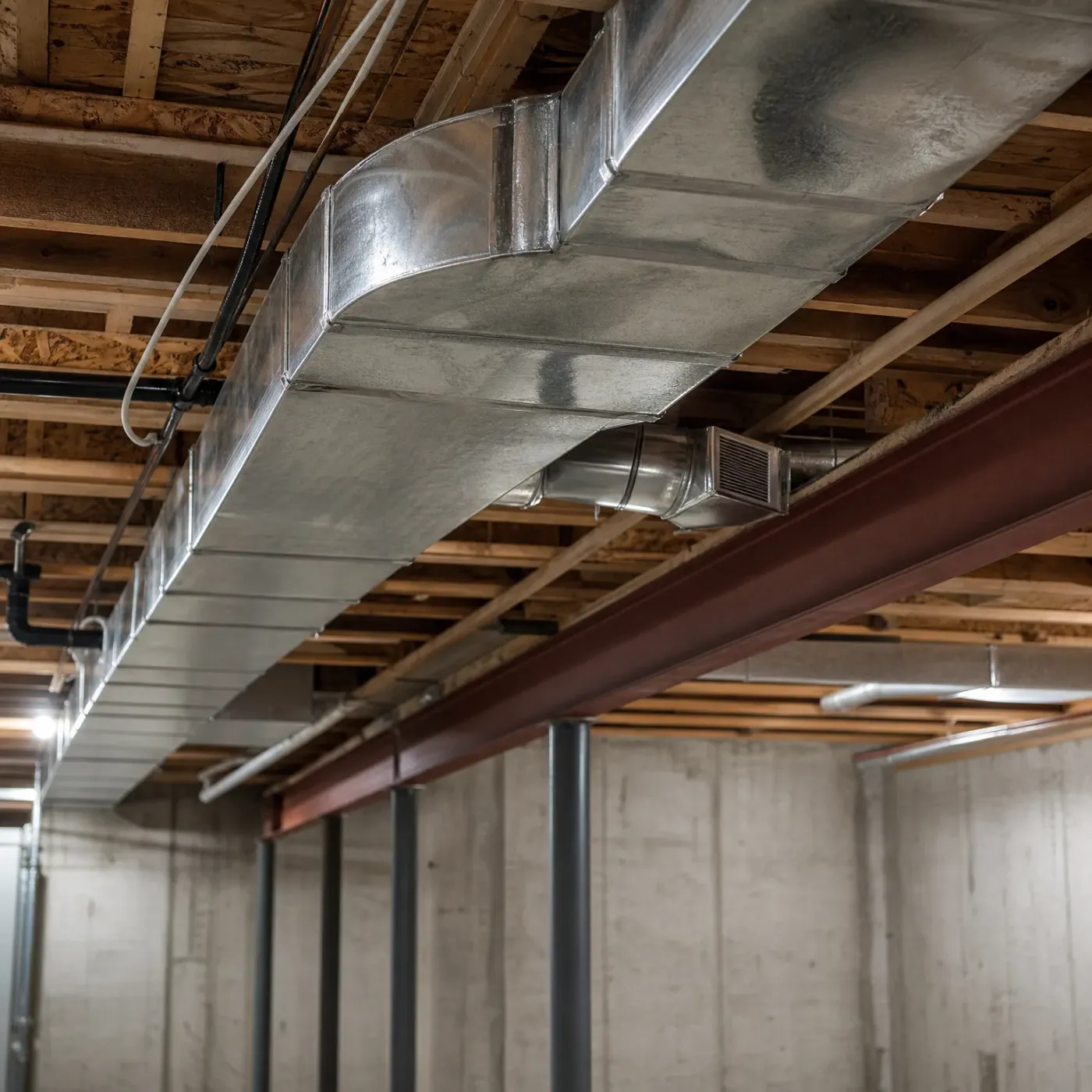
Galvanized sheet metal trunk ductwork with a round branch and register running beneath wood floor joists in an unfinished basement, alongside pipes, wiring, a steel beam and concrete walls.

Send one request and you're done looking

Skip calling around for someone who cleans ducts.

Send the form and finding a duct cleaner is handled.

Hand off the search

It costs nothing to send, and you don't have to hire anyone.

Unfinished basement with bare concrete floor and walls, exposed wood joists, large galvanized sheet-metal ductwork, PVC and copper piping, and a gray furnace unit beside wood stud framing.
Ductwork like this moves air the way it should, with ducts and drain lines running clean and intact across the joists.
Basement ceiling with large galvanized sheet-metal ductwork, round metal pipes and plumbing lines running beneath wood joists, above a bare concrete wall and floor.
Water staining on the foundation wall like this means moisture has a way in, and damp ductwork is a reason to clean sooner.
  1. Dust and debris get loosened from the inside walls of each duct run

  2. A powerful vacuum connected to the system pulls loosened debris out

  3. Supply and return vents are cleaned where dust collects most

  4. The blower motor and coil get wiped down if they're reachable

A bearded man in a navy T-shirt sits on a light-colored couch indoors, smiling while looking down at a laptop screen in the foreground, with a framed picture and a potted plant blurred behind him.
A bearded man in a plaid flannel shirt stands indoors looking out a window at snow-covered conifers, with a ceramic mug on the wooden sill and wooden cabinets behind him.

Call someone now

A contractor looks at your ducts and tells you what they actually need, instead of guessing from a schedule that fits most houses but not necessarily yours.

Send my request

Wait and see

You hold off until the ring around the vents or the musty smell shows up, then start looking for someone to call once it already bothers you.

Send my request

Power costs 15.46 cents per kilowatt-hour statewide

At 15.46 cents a kilowatt-hour, your heat pump or electric furnace is already working for its money. Dust caked on the blower wheel or coil makes it push harder to move the same air, and that shows up on the bill. Clean ducts let it do less work for the same heat.

EIA-861 2025 statewide residential average

Empty basement with bare concrete walls and floor, a small window at left, and exposed wood joists with galvanized sheet metal ductwork and pipes overhead.

Ductwork running clean

This is what the joists above a new basement look like. The sheet metal and flex pipe run straight across, fitted tight at the seams, with nothing hanging loose or coated in buildup. Air moves through without picking up anything extra on the way.

Dusty sheet-metal HVAC ducts with a rectangular vent register run beneath wooden floor joists above an empty concrete-walled basement.

Ductwork carrying grime

Here the duct is dark with dust along its whole run, thick enough to see from across the room. Every pass of air through this stirs some of that grime loose and sends it into the rooms above. That's what shows up as a dustier house and vents with a ring around the edge.

A closed silver laptop and a white cup of coffee on a saucer sit on a wooden table in front of a wooden chair, a plain beige wall, a potted leafy plant and a window with greenery outside.

Every 3 to 5 years, with an eye on what's actually happening in your house

That's the mark for most houses in Oregon. Your ducts might need attention sooner if there's a musty smell, a dark ring around the vents, or dust that keeps coming back no matter how often you clean. None of that is unusual, and none of it means something is badly wrong. It just means it's time.

Finding out who to call is the part that eats an afternoon. You end up searching, calling a few places, explaining the vents and the smell and the dust all over again to each one, then sitting with quotes trying to figure out who actually knows what they're doing. Send the form once and that work is off your plate. A contractor gets in touch, looks at your ducts, and tells you what they need, and you go back to the rest of your day.

A large weathered ceramic vase and a shallow wooden bowl sit on a rustic wooden table beside a window with linen curtains, with a blurred sofa with cushions and a hanging fabric panel in the background.
A modern two-story house with dark siding and stone base at dusk, with lit soffit lights, a path of large rectangular pavers set in dark gravel, planting beds, a lawn, and an orange and blue sunset sky above distant trees and water.

Ductwork Cleaning

Let someone else find the pro

Duct and vent cleaningDucts or ventsOregon
Step 1 of 2

What ZIP code is the job in?

  • A gray upholstered sofa arm with a cream knit fringed throw sits beside a wooden side table holding a stack of books, a shallow wooden bowl, and a ceramic vase of leafy branches, on a wood floor near a window.
    • A local pro who cleans ducts gets in touch with you.
    • Your duct cleaning request goes to a local pro who does this work.
  • A living room corner with a cream upholstered sofa and cushion beside a wooden side table holding a ceramic vase of olive branches and a small dark bowl, with a framed landscape painting on the gray wall and a linen curtain at the window.
    • After this form, you can stop searching for a duct system pro.
    • Once you send the form, finding a pro is off your list.
  • A wood-framed armchair with a beige cushion and knitted throw sits beside a round wooden side table holding a ceramic mug, with a potted green plant near a window in the corner and a framed picture on the wall.
    • Answer a few questions instead of calling shop after shop.
    • Describe your ductwork job once, to one pro.
  • Interior corner with beadboard wainscoting, a gray cabinet with wood countertop holding a vase of greenery below a window, and a potted leafy plant in a woven basket on a wood floor with a fringed jute rug.
    • Your duct cleaning request goes to one local pro.
    • Your request goes to one pro, not a list of companies.