Mini Split Installation in The Dalles, OR
A new system here will heat from September through June and cool from July through August every year. Tell us about the house, and a licensed contractor who covers Wasco County will get in touch.
Tell us about the job
It takes about a minute.
A mini-split here runs most of the year
The Dalles needs heat from September through June, then cooling in July and August. That is twelve months of work, ten of them for heat. Winter nights average 27°F, cold enough that a heat pump has to work for every degree it pulls from the outside air. Summer afternoons average 80°F, a lighter job than the winter side asks of it.
Any mini-split installed now has to meet the federal minimum for split-system heat pumps, 14.3 SEER2 for cooling and 7.5 HSPF2 for heating. With ten months of heating and two of cooling, the heating side is the one doing most of the work here.
- 10 months
- September through June, your system heats
- 2 months
- July through August, it cools
- 27°F
- the average winter night it heats against
- 80°F
- the average summer afternoon it cools against
NOAA nClimDiv, 1991–2020 normals
Oregon requires HVAC contractors to hold a state license.
Oregon licenses HVAC contractors through the Construction Contractors Board, which tests contractors and keeps a record of who holds a license. The license belongs to the contractor, not to any single job, so it carries over from one house to the next. Work under $1,000 does not need a licensed contractor in Oregon, but a mini-split installation runs well past that mark, so the contractor doing this job needs to hold the license.
Most cities and counties in Oregon require a permit for an installation like this, with an inspection once the work is done. That inspection is a separate check, someone from the local building office looking at the work itself, apart from whatever the license already tells you about the contractor.
Source: Oregon Legislative Assembly
- Is a mini split worth it?
- For most homes here, yes, because a mini split heats and cools, and this area needs one or the other twelve months a year. Winter nights average 27°F, so the heat pump has real work to do from September through June. Summers stay mild, averaging 80°F in the afternoon, so the same system covers the short cooling season too. The main tradeoff is picking a unit sized right for the rooms it serves, which is worth going over with a contractor before you decide.
- How many rooms can a mini split cover?
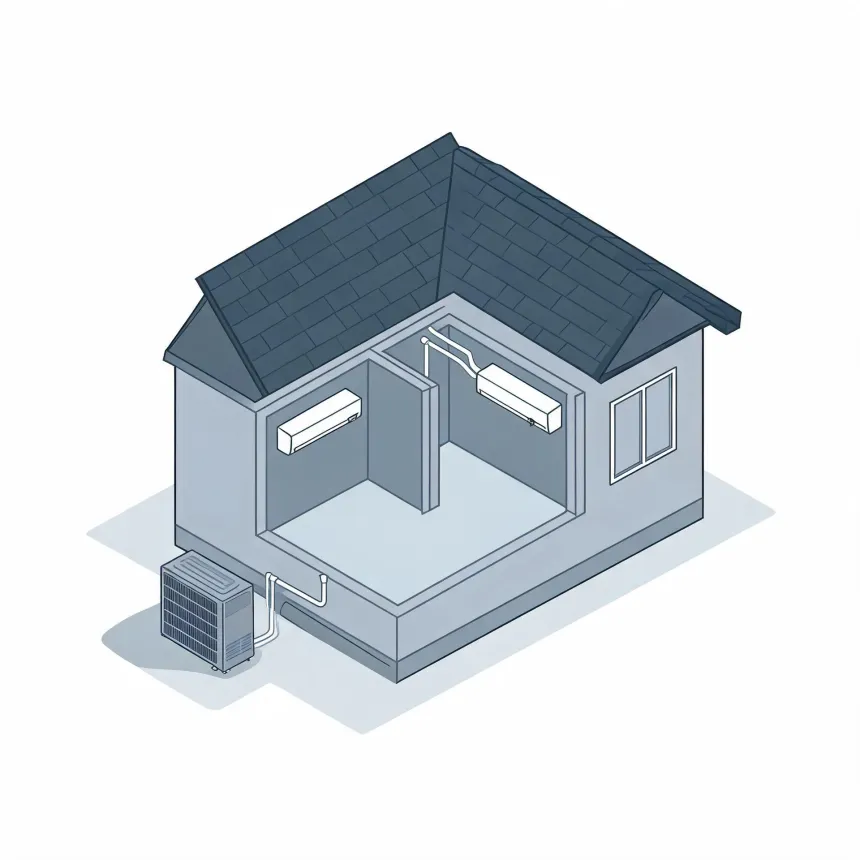
- A single outdoor unit can run one indoor head or several, depending on the system. Single-zone systems cover one room or open area. Multi-zone systems connect several indoor heads to one outdoor unit, each with its own thermostat, so you can cover more than one room and control each separately. How many rooms makes sense for a given house depends on the layout, and a contractor can work that out room by room.
- Can a mini split heat a whole house?
- It can, if there are enough indoor heads placed to reach every room, or if it's paired with the home's existing heating. A single indoor unit only heats the space it's in and maybe an open area nearby, so a whole house usually needs a multi-zone system sized for each room. With winter lows here averaging 27°F, the system needs to be sized for that cold, not just for a mild day. A contractor can size it against the house's actual rooms and layout.